
Dean's First-Generation Scholarship
New scholarship aims to help first-generation students jump financial hurdles
The financial burden for a college education can be great. Many first-generation students come from financially disadvantaged backgrounds and don’t have family income to rely on to finance their education. And not having the means to finance an education can stand in the way of students earning their degrees.
This financial hurdle can be even greater for medical school and can derail a student’s dream of becoming a physician. The Stritch Dean’s First-Generation Scholarship was created to help reduce that barrier for students who are the first in their families to graduate from college.
As a first-generation student himself, Stritch Dean Sam J. Marzo (MD ’91) was driven to start the scholarship to help those students earn medical degrees from Loyola University Chicago Stritch School of Medicine and continue the Jesuit tradition of becoming physicians who strive for excellence in the spirit of compassion, discernment, and service.
According to Dean Marzo, training current and future medical students is very expensive due to the high-touch, people-intensive resources required to effectively train students to become competent, caring physicians. Medical school tuition has continued to increase for all medical schools year after year due to various causes, including inflation, implementation of new educational technologies, and cost of living increases for employees. While all students are affected, first-generation students are particularly at risk.
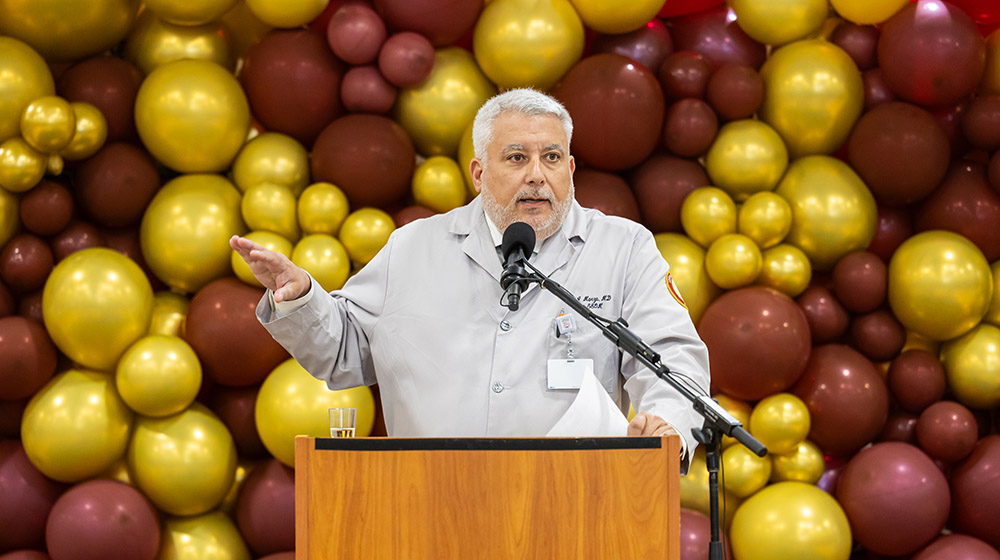
“If Stritch can help lessen the tuition burden for these students, then the school is likely to recruit more of them to the benefit of the field of medicine and the communities in which they practice.”
— Sam J. Marzo (MD ‘91), Dean of Stritch School of Medicine, Professor of Otolaryngology - Head & Neck Surgery and Neurosurgery
From first-generation student to physician leader
Dean Marzo’s father was an auto mechanic and mother was a bookkeeper. He was the oldest and only boy with three younger sisters. Of his upbringing, he said, “While we almost never went out to eat or had summer vacations, my parents created a warm, encouraging home environment that stressed God, family, hard work, and a strong Catholic education.”
He started working as a caddie at age 12 at a local country club and received the Chick Evans Scholarship that provided four years of tuition and housing at the University of Illinois at Champaign Urbana where he majored in Biochemistry. He initially considered getting a PhD but really enjoyed seeing how compassionately and skillfully the physicians cared for patients while working in a dialysis unit one summer break. Feeling more drawn to medicine than research after that experience, Dean Marzo applied to Stritch and was accepted—and he needed to take out loans to finance his education.
This is a tale that many first-generation students can relate to. Dean Marzo explains, “First-generation students often come from modest means, or are recent immigrants just gaining their financial footing in the U.S., or have parents with limited educational background, or all of the above.” He says, “We come from loving families and are taught servant leadership at home. We are very grateful to our families and this country and want to be of service to others. I started the first-generation scholarship with this in mind.”
Making a difference through donor support
Philanthropic donations were integral to being able to start to the Dean’s First-Generation Scholarship fund. Many Stritch alumni are first-generation college graduates and understand how challenging the financial aspect of an education can be.
Robert F. Conti (MD ’55) is a Stritch alumni and first-generation student who was driven to donate to the fund, because he knows firsthand the challenge of overcoming financial barriers in medical school. Both of his parents arrived in the United States in the early 1900s. His mother came to the U.S. with her family, while his father arrived alone as a teenager, never having had any formal education and making his own way in this new country.
Dr. Conti said that when he heard about the creation of the First-Generation Scholarship, he thought “How great it would have been for me to apply for help from this fund!”
He added, “It is for this reason that I and my family are supportive of this scholarship and plan to contribute annually. The Stritch School of Medicine contributed greatly to my life, and this is our way of passing it forward.”
Looking to the future
Stritch is one of only four Jesuit, Catholic medical schools in the United States and is deeply committed to preparing students to become excellent clinicians and provide outstanding patient care. At Stritch, 10% of the medical students are first-generation college students. Nationally, the average medical student will graduate with over $200,000 in debt. Additionally, the recent loss of the federal Grad PLUS loan on a federal level removes a crucial financial lifeline for first-generation medical students, many of whom may lack family resources to cover the full cost of attendance. Without this support, these students face larger financial barriers, higher private loan debt, and an increased risk of being unable to pursue or complete their medical education.
Dean Marzo explains, “If Stritch can help lessen the tuition burden for these students, then the school is likely to recruit more of them to the benefit of the field of medicine and the communities in which they practice.”
The first scholarship was awarded to a first-year student in the 2025-26 academic year. The goal is to award one scholarship per year for the next four academic years, so there is one student funded in each class by the 2028-29 academic year.
More information:
- To learn more about the scholarship, please contact Abigail Leng, Director of Development, at aleng@luc.edu.
- Donate to the Dean’s First-Generation Scholarship.
- Stritch students who have questions about financial aid resources available to them can email ssomfinaid@luc.edu.
The financial burden for a college education can be great. Many first-generation students come from financially disadvantaged backgrounds and don’t have family income to rely on to finance their education. And not having the means to finance an education can stand in the way of students earning their degrees.
This financial hurdle can be even greater for medical school and can derail a student’s dream of becoming a physician. The Stritch Dean’s First-Generation Scholarship was created to help reduce that barrier for students who are the first in their families to graduate from college.
As a first-generation student himself, Stritch Dean Sam J. Marzo (MD ’91) was driven to start the scholarship to help those students earn medical degrees from Loyola University Chicago Stritch School of Medicine and continue the Jesuit tradition of becoming physicians who strive for excellence in the spirit of compassion, discernment, and service.
According to Dean Marzo, training current and future medical students is very expensive due to the high-touch, people-intensive resources required to effectively train students to become competent, caring physicians. Medical school tuition has continued to increase for all medical schools year after year due to various causes, including inflation, implementation of new educational technologies, and cost of living increases for employees. While all students are affected, first-generation students are particularly at risk.
From first-generation student to physician leader
Dean Marzo’s father was an auto mechanic and mother was a bookkeeper. He was the oldest and only boy with three younger sisters. Of his upbringing, he said, “While we almost never went out to eat or had summer vacations, my parents created a warm, encouraging home environment that stressed God, family, hard work, and a strong Catholic education.”
He started working as a caddie at age 12 at a local country club and received the Chick Evans Scholarship that provided four years of tuition and housing at the University of Illinois at Champaign Urbana where he majored in Biochemistry. He initially considered getting a PhD but really enjoyed seeing how compassionately and skillfully the physicians cared for patients while working in a dialysis unit one summer break. Feeling more drawn to medicine than research after that experience, Dean Marzo applied to Stritch and was accepted—and he needed to take out loans to finance his education.
This is a tale that many first-generation students can relate to. Dean Marzo explains, “First-generation students often come from modest means, or are recent immigrants just gaining their financial footing in the U.S., or have parents with limited educational background, or all of the above.” He says, “We come from loving families and are taught servant leadership at home. We are very grateful to our families and this country and want to be of service to others. I started the first-generation scholarship with this in mind.”
Making a difference through donor support
Philanthropic donations were integral to being able to start to the Dean’s First-Generation Scholarship fund. Many Stritch alumni are first-generation college graduates and understand how challenging the financial aspect of an education can be.
Robert F. Conti (MD ’55) is a Stritch alumni and first-generation student who was driven to donate to the fund, because he knows firsthand the challenge of overcoming financial barriers in medical school. Both of his parents arrived in the United States in the early 1900s. His mother came to the U.S. with her family, while his father arrived alone as a teenager, never having had any formal education and making his own way in this new country.
Dr. Conti said that when he heard about the creation of the First-Generation Scholarship, he thought “How great it would have been for me to apply for help from this fund!”
He added, “It is for this reason that I and my family are supportive of this scholarship and plan to contribute annually. The Stritch School of Medicine contributed greatly to my life, and this is our way of passing it forward.”
Looking to the future
Stritch is one of only four Jesuit, Catholic medical schools in the United States and is deeply committed to preparing students to become excellent clinicians and provide outstanding patient care. At Stritch, 10% of the medical students are first-generation college students. Nationally, the average medical student will graduate with over $200,000 in debt. Additionally, the recent loss of the federal Grad PLUS loan on a federal level removes a crucial financial lifeline for first-generation medical students, many of whom may lack family resources to cover the full cost of attendance. Without this support, these students face larger financial barriers, higher private loan debt, and an increased risk of being unable to pursue or complete their medical education.
Dean Marzo explains, “If Stritch can help lessen the tuition burden for these students, then the school is likely to recruit more of them to the benefit of the field of medicine and the communities in which they practice.”
The first scholarship was awarded to a first-year student in the 2025-26 academic year. The goal is to award one scholarship per year for the next four academic years, so there is one student funded in each class by the 2028-29 academic year.
More information:
- To learn more about the scholarship, please contact Abigail Leng, Director of Development, at aleng@luc.edu.
- Donate to the Dean’s First-Generation Scholarship.
- Stritch students who have questions about financial aid resources available to them can email ssomfinaid@luc.edu.